Due to some technical difficulties, the alignment of the pictures and words are not in proper. Sorry for the inconvenience caused.
Thursday, June 30, 2011
Excursion trip to Nee Soon Swamp Forest
Go to site: https://sites.google.com/site/scienceeport/home/excursion-trip-to-nee-soon-swamp-forest and click on the attachments below to see my excursion trip to Nee Soon Swamp Forest.

Sulfuric Acid
General background:
Sulfuric acid is a chemical compound H2SO4 that is colorless, odorless, extremely corrosive, oily liquid and is sometimes called oil of vitriol. Balanced equation: H2SO4 H2 + SO42−
Uses of sulfuric acid:
1. Serves as electrolyte in lead-acid storage battery.
a. Acid for this use, containing about 33% H2SO4 and with specific gravity about 1.25, is often called battery acid.
b. Commonly used in motor vehicles.
2. Crucial in the production of fertilizers.
a. Examples: Superphosphate of lime (CaCO3) and ammonium sulfate (NH4)2SO4, which is formed when rock phosphate is treated with sulfuric acid.
3. Used to remove oxides and rusts from iron and steel before plating them with tin or zinc.
4. Dehydrating agent to remove water (only for concentrated sulfuric acid).
a. It has a tendency to form hydrates such as H2SO4.H2O, H2SO4.2H2O, etc.
5. Used to dry neutral and acidic gases.
a. Examples: Nitrogen gas N2, Oxygen gas O2, Carbon dioxide CO2, Sulfur dioxide SO2 etc.
6. Remove water from carbohydrates and some other organic compounds which contain oxygen and hydrogen.
a. Examples: React with sucrose or cane sugar C12H22O11(s) to produce a spongy mass of carbon:
i. C12H22O11(s) + 11H2SO4 12C(s) + 11H2SO4.H2O
7. Used in production of nitroglycerine, an inorganic ester and organic nitrate.
a. Used as an explosive.
b. Used as a vasodilator that is a substance that dilates blood vessels and can be used in the treatment of certain types of heart disease.
8. Used in petroleum refining to wash impurities out of gasoline and other refinery products.
9. Used to make rayon.
10. Use in the manufacturing of other chemicals.
a. Examples: hydrochloric acid, nitric acid, sulfate salts, synthetic detergents, dyes and pigments, explosives, and drugs.
Manufacture of sulfuric acid:
General background: There are two major processes in the manufacturing and production of sulfuric acid, namely the Lead Chamber Process and the Lead Contact Process, with the Lead Chamber Process being the older of the two. The Lead Chamber Process is used to produce much of the acid used to make fertilizers and produces a relatively dilute acid of 62%–78% sulfuric acid whereas the contact process produces a much purer, more concentrated acid but requires purer raw materials and the use of expensive catalysts. Both processes are similar in the oxidized of sulfur dioxide and the dissolving of sulfur dioxide in water.
1. Lead Chamber Process
History
In 1746 John Roebuck developed the Lead Chamber Process for the manufacture of sulfuric acid. Prior to this time, sulfuric acid had been produced in glass bottles several pounds at a time. But the lead chamber process could produce sulfuric acid by the ton. However, this manufacturing process was a batch process and resulted in the consumption of potassium nitrate. In 1835, Joseph Gay-Lussac improved the manufacturing process.
Process
John Roebuck’s Lead Chamber Process:
a) In the original lead chamber process, sulfur and potassium nitrate are ignited in a room lined with lead foil. Potassium nitrate, or saltpeter is an oxidizing agent oxidizes the sulfur to sulfur trioxide.
a. Chemical equation: 6 KNO3(s) + 7 S(s) -----> 3 K2S + 6 NO(g) + 4 SO3(g)
b) The floor of the room was covered with water. When the sulfur trioxide reacted with the water, sulfuric acid was produced.
a. SO3(g) + H2O(l) -----> H2SO4(aq)
Joseph Gay-Lussac’s improvement:
a) A process for recovering the nitrogen in nitrogen monoxide and recycling it to replace the saltpeter as a source of nitrogen was invented.
a. Chemical equation: 4 NO(g) + O2(g) + 2 H2O(l) -----> 4 HNO2(l)
b. Chemical equation: 4 HNO2(l) + 2 SO2(g) -----> 2 H2SO4(aq) + 4 NO(g)
b) Reduced the dependence on expensive saltpeter and sharply reduced nitrogen monoxide emissions.
Lead Chamber Process after improvements:
a) Hot sulfur dioxide gas enters the bottom of a reactor called a Glover tower where it is washed with nitrous vitriol (sulfuric acid with nitric oxide and nitrogen dioxide dissolved in it) and mixed with nitric oxide and nitrogen dioxide gases.
a. Two functions of the Glover tower:
i. Concentration of the chamber acid (62% to 68% H2SO4) is achieved by the hot gases entering the tower which evaporate water from the acid. Some of the sulfur dioxide is oxidized to sulfur trioxide and dissolved in the acid wash to form tower acid or Glover acid (about 78% H2SO4).
ii. Dissolved nitrogen oxides are stripped from the acid and carried with the gas out of the Glover tower into the lead chambers.
b) From the Glover tower, a mixture of gases – including sulfur dioxide and trioxide, nitrogen oxides, nitrogen, oxygen, and steam – is transferred to a lead-lined chamber where it is reacted with more water.
a. Lead-lined chamber: A large, boxlike room or an enclosure in the form of a truncated cone.
b. Sulfuric acid condenses on the walls and collects on the floor of the chamber.
c. The gases pass through each in succession of the three to twelve chambers in a series.
d. The acid produced in the chambers, often called chamber acid or fertilizer acid, contains 62% to 68% H2SO4.
e. Chemical equation: 2 SO2 + O2 + 2 H2O -----> 2 H2SO4
c) After the gases have passed through the chambers they are passed into a reactor called the Gay-Lussac tower where they are washed with cooled concentrated acid from the Glover tower.
a. The nitrogen oxides and unreacted sulfur dioxide dissolve in the acid to form the nitrous vitriol used in the Glover tower.
b. The waste gases exiting the Guy-Lussac tower are usually discharged into the atmosphere.
d) Product acid at a concentration of 78% H2SO4 is drawn from the cooled acid stream that is circulated from the Glover tower to the Guy-Lussac tower. Nitrogen losses are made up with nitric acid which is added to the Glover tower.
2. Contact Process: A process involving the catalytic oxidation of sulfur dioxide, SO2, to sulfur trioxide, SO3.
History
The first observation of a “contact” or heterogeneous catalytic reaction seems to have been made by Edmund Davy in 1817. He noted that heated platinum wire introduced into a mixture of oxygen or air with hydrogen, carbon monoxide, or ethylene became hotter and finally glowed with rapid combustion of the mixture. In 1831 Peregrine Phillips, a vinegar manufacturer in Bristol, England, patented a new process in British Patent No. 6096. The patent described the instantaneous union of sulfur dioxide with atmospheric oxygen when passing the mixture over platinum which had been heated to a strong yellow heat, with the sulfur trioxide formed rapidly absorbed when contacted with water to form sulfuric acid. In spite of the obvious advantages of the contact process over chamber plants for the production of high strength sulfuric acid and oleum used for dyes and nitrocellulose (smokeless powder), the commercial development of the process was extremely slow. Chemical technology of the time, especially involving catalytic reactions, was limited.
Process
a) Solid sulfur, S(s), is burned in air to form sulfur dioxide gas, SO2.
a. Chemical equation: S(s) + O2(g) SO2(g)
b) The gases are mixed with more air then cleaned by electrostatic precipitation to remove any particulate matter.
c) The mixture of sulfur dioxide and air is heated to 450oC and subjected to a pressure of 101.3 - 202.6 kPa (1 -2 atmospheres) in the presence of a catalyst, which is often platinum on a silica/ asbestos carrier/ vanadium pentoxide on a silica carrier (vanadium oxide) to produce sulfur trioxide, SO3(g), with a yield of 98%.
a. Chemical equation: 2SO2(g) + O2(g) 2SO3(g)
d) Any unreacted gases from the above reaction are recycled back into the above reaction.
e) The sulfur trioxide is cooled and passed through two towers.
a. In the first tower, sulfur trioxide, SO3(g) is dissolved in 98% sulfuric acid, H2SO4, to produce disulfuric acid or pyrosulfuric acid, also known as fuming sulfuric acid or oleum, H2S2O7.
i. Chemical equation: SO3(g) + H2SO4 ------> H2S2O7
ii. This is done because when water is added directly to sulfur trioxide to produce sulfuric acid.
iii. Chemical equation: SO3(g) + H2O(l) -----> H2SO4(l)
iv. The reaction is slow and tends to form a mist in which the particles refuse to coalesce (bond).
v. Note: This cannot be done by simply adding water to the sulphur trioxide – the reaction is too uncontrollable that it creates a fog of sulphuric acid.
b. Water is added to the disulfuric acid, H2S2O7, to produce sulfuric acid, H2SO4
c. Chemical equation: H2S2O7(l) + H2O(l) -----> 2H2SO4(l)
d. Note: This can then be reacted safely with water to produce concentrated sulphuric acid - twice as much as you originally used to make the fuming sulphuric acid.
References:
http://www.ausetute.com.au/sulfacid.html
http://www.infoplease.com/ce6/sci/A0861350.html
http://www.infoplease.com/ce6/sci/A0861351.html
http://www.chemguide.co.uk/physical/equilibria/contact.html
www.aiche-cf.org/Clearwater/2008/Paper2/8.2.7.pdf
http://en.wikipedia.org/wiki/Sulfuric_acid
http://web.fccj.org/~ethall/h2so4/h2so4.htm
http://scifun.chem.wisc.edu/chemweek/sulf&top/sulf&top.html
http://www.factmonster.com/ce6/sci/A0861351.html
http://www.factmonster.com/ce6/sci/A0861350.html
http://www.buzzle.com/articles/sulfuric-acid-uses.html
Sulfuric acid is a chemical compound H2SO4 that is colorless, odorless, extremely corrosive, oily liquid and is sometimes called oil of vitriol. Balanced equation: H2SO4 H2 + SO42−
Uses of sulfuric acid:
1. Serves as electrolyte in lead-acid storage battery.
a. Acid for this use, containing about 33% H2SO4 and with specific gravity about 1.25, is often called battery acid.
b. Commonly used in motor vehicles.
2. Crucial in the production of fertilizers.
a. Examples: Superphosphate of lime (CaCO3) and ammonium sulfate (NH4)2SO4, which is formed when rock phosphate is treated with sulfuric acid.
3. Used to remove oxides and rusts from iron and steel before plating them with tin or zinc.
4. Dehydrating agent to remove water (only for concentrated sulfuric acid).
a. It has a tendency to form hydrates such as H2SO4.H2O, H2SO4.2H2O, etc.
5. Used to dry neutral and acidic gases.
a. Examples: Nitrogen gas N2, Oxygen gas O2, Carbon dioxide CO2, Sulfur dioxide SO2 etc.
6. Remove water from carbohydrates and some other organic compounds which contain oxygen and hydrogen.
a. Examples: React with sucrose or cane sugar C12H22O11(s) to produce a spongy mass of carbon:
i. C12H22O11(s) + 11H2SO4 12C(s) + 11H2SO4.H2O
7. Used in production of nitroglycerine, an inorganic ester and organic nitrate.
a. Used as an explosive.
b. Used as a vasodilator that is a substance that dilates blood vessels and can be used in the treatment of certain types of heart disease.
8. Used in petroleum refining to wash impurities out of gasoline and other refinery products.
9. Used to make rayon.
10. Use in the manufacturing of other chemicals.
a. Examples: hydrochloric acid, nitric acid, sulfate salts, synthetic detergents, dyes and pigments, explosives, and drugs.
Manufacture of sulfuric acid:
General background: There are two major processes in the manufacturing and production of sulfuric acid, namely the Lead Chamber Process and the Lead Contact Process, with the Lead Chamber Process being the older of the two. The Lead Chamber Process is used to produce much of the acid used to make fertilizers and produces a relatively dilute acid of 62%–78% sulfuric acid whereas the contact process produces a much purer, more concentrated acid but requires purer raw materials and the use of expensive catalysts. Both processes are similar in the oxidized of sulfur dioxide and the dissolving of sulfur dioxide in water.
1. Lead Chamber Process
History
In 1746 John Roebuck developed the Lead Chamber Process for the manufacture of sulfuric acid. Prior to this time, sulfuric acid had been produced in glass bottles several pounds at a time. But the lead chamber process could produce sulfuric acid by the ton. However, this manufacturing process was a batch process and resulted in the consumption of potassium nitrate. In 1835, Joseph Gay-Lussac improved the manufacturing process.
Process
John Roebuck’s Lead Chamber Process:
a) In the original lead chamber process, sulfur and potassium nitrate are ignited in a room lined with lead foil. Potassium nitrate, or saltpeter is an oxidizing agent oxidizes the sulfur to sulfur trioxide.
a. Chemical equation: 6 KNO3(s) + 7 S(s) -----> 3 K2S + 6 NO(g) + 4 SO3(g)
b) The floor of the room was covered with water. When the sulfur trioxide reacted with the water, sulfuric acid was produced.
a. SO3(g) + H2O(l) -----> H2SO4(aq)
Joseph Gay-Lussac’s improvement:
a) A process for recovering the nitrogen in nitrogen monoxide and recycling it to replace the saltpeter as a source of nitrogen was invented.
a. Chemical equation: 4 NO(g) + O2(g) + 2 H2O(l) -----> 4 HNO2(l)
b. Chemical equation: 4 HNO2(l) + 2 SO2(g) -----> 2 H2SO4(aq) + 4 NO(g)
b) Reduced the dependence on expensive saltpeter and sharply reduced nitrogen monoxide emissions.
Lead Chamber Process after improvements:
a) Hot sulfur dioxide gas enters the bottom of a reactor called a Glover tower where it is washed with nitrous vitriol (sulfuric acid with nitric oxide and nitrogen dioxide dissolved in it) and mixed with nitric oxide and nitrogen dioxide gases.
a. Two functions of the Glover tower:
i. Concentration of the chamber acid (62% to 68% H2SO4) is achieved by the hot gases entering the tower which evaporate water from the acid. Some of the sulfur dioxide is oxidized to sulfur trioxide and dissolved in the acid wash to form tower acid or Glover acid (about 78% H2SO4).
ii. Dissolved nitrogen oxides are stripped from the acid and carried with the gas out of the Glover tower into the lead chambers.
b) From the Glover tower, a mixture of gases – including sulfur dioxide and trioxide, nitrogen oxides, nitrogen, oxygen, and steam – is transferred to a lead-lined chamber where it is reacted with more water.
a. Lead-lined chamber: A large, boxlike room or an enclosure in the form of a truncated cone.
b. Sulfuric acid condenses on the walls and collects on the floor of the chamber.
c. The gases pass through each in succession of the three to twelve chambers in a series.
d. The acid produced in the chambers, often called chamber acid or fertilizer acid, contains 62% to 68% H2SO4.
e. Chemical equation: 2 SO2 + O2 + 2 H2O -----> 2 H2SO4
c) After the gases have passed through the chambers they are passed into a reactor called the Gay-Lussac tower where they are washed with cooled concentrated acid from the Glover tower.
a. The nitrogen oxides and unreacted sulfur dioxide dissolve in the acid to form the nitrous vitriol used in the Glover tower.
b. The waste gases exiting the Guy-Lussac tower are usually discharged into the atmosphere.
d) Product acid at a concentration of 78% H2SO4 is drawn from the cooled acid stream that is circulated from the Glover tower to the Guy-Lussac tower. Nitrogen losses are made up with nitric acid which is added to the Glover tower.
2. Contact Process: A process involving the catalytic oxidation of sulfur dioxide, SO2, to sulfur trioxide, SO3.
History
The first observation of a “contact” or heterogeneous catalytic reaction seems to have been made by Edmund Davy in 1817. He noted that heated platinum wire introduced into a mixture of oxygen or air with hydrogen, carbon monoxide, or ethylene became hotter and finally glowed with rapid combustion of the mixture. In 1831 Peregrine Phillips, a vinegar manufacturer in Bristol, England, patented a new process in British Patent No. 6096. The patent described the instantaneous union of sulfur dioxide with atmospheric oxygen when passing the mixture over platinum which had been heated to a strong yellow heat, with the sulfur trioxide formed rapidly absorbed when contacted with water to form sulfuric acid. In spite of the obvious advantages of the contact process over chamber plants for the production of high strength sulfuric acid and oleum used for dyes and nitrocellulose (smokeless powder), the commercial development of the process was extremely slow. Chemical technology of the time, especially involving catalytic reactions, was limited.
Process
a) Solid sulfur, S(s), is burned in air to form sulfur dioxide gas, SO2.
a. Chemical equation: S(s) + O2(g) SO2(g)
b) The gases are mixed with more air then cleaned by electrostatic precipitation to remove any particulate matter.
c) The mixture of sulfur dioxide and air is heated to 450oC and subjected to a pressure of 101.3 - 202.6 kPa (1 -2 atmospheres) in the presence of a catalyst, which is often platinum on a silica/ asbestos carrier/ vanadium pentoxide on a silica carrier (vanadium oxide) to produce sulfur trioxide, SO3(g), with a yield of 98%.
a. Chemical equation: 2SO2(g) + O2(g) 2SO3(g)
d) Any unreacted gases from the above reaction are recycled back into the above reaction.
e) The sulfur trioxide is cooled and passed through two towers.
a. In the first tower, sulfur trioxide, SO3(g) is dissolved in 98% sulfuric acid, H2SO4, to produce disulfuric acid or pyrosulfuric acid, also known as fuming sulfuric acid or oleum, H2S2O7.
i. Chemical equation: SO3(g) + H2SO4 ------> H2S2O7
ii. This is done because when water is added directly to sulfur trioxide to produce sulfuric acid.
iii. Chemical equation: SO3(g) + H2O(l) -----> H2SO4(l)
iv. The reaction is slow and tends to form a mist in which the particles refuse to coalesce (bond).
v. Note: This cannot be done by simply adding water to the sulphur trioxide – the reaction is too uncontrollable that it creates a fog of sulphuric acid.
b. Water is added to the disulfuric acid, H2S2O7, to produce sulfuric acid, H2SO4
c. Chemical equation: H2S2O7(l) + H2O(l) -----> 2H2SO4(l)
d. Note: This can then be reacted safely with water to produce concentrated sulphuric acid - twice as much as you originally used to make the fuming sulphuric acid.
References:
http://www.ausetute.com.au/sulfacid.html
http://www.infoplease.com/ce6/sci/A0861350.html
http://www.infoplease.com/ce6/sci/A0861351.html
http://www.chemguide.co.uk/physical/equilibria/contact.html
www.aiche-cf.org/Clearwater/2008/Paper2/8.2.7.pdf
http://en.wikipedia.org/wiki/Sulfuric_acid
http://web.fccj.org/~ethall/h2so4/h2so4.htm
http://scifun.chem.wisc.edu/chemweek/sulf&top/sulf&top.html
http://www.factmonster.com/ce6/sci/A0861351.html
http://www.factmonster.com/ce6/sci/A0861350.html
http://www.buzzle.com/articles/sulfuric-acid-uses.html
Development of the Periodic Table
Attempts made by Johann Wolfgang Döbereiner:

The development of the periodic table begins with German chemist Johann Wolfgang Döbereiner (1780-1849) who grouped certain elements based on similarities and anticipated the development of the periodic system of elements, such as grouping the group I (alkali metal) elements lithium, sodium and potassium together for being soft, reactive metals. He also noticed other patterns in the group I elements, such as all react with water at room temperature and react with chlorine to form compounds with similar formulas: LiCl, NaCl, and KCl, combine with hydrogen to form compounds with similar formulas: LiH, NaH, and KH and form hydroxides with similar formulas: LiOH, NaOH, and KOH.
Döbereiner recalled a comparable graduation of properties in two other sequences—calcium, strontium, barium; and sulfur, selenium, tellurium. Calcium (atomic weight 40), strontium (atomic weight 88), and barium (atomic weight 137) possess similar chemical prepares and Döbereiner noticed the atomic weight of strontium fell midway between the weights of calcium and barium:
Calcium (Ca) Strontium (Sr) Barium (Ba)
40 88 137
(40 + 137) ÷ 2 = 88
Dobereiner also noticed the same pattern for the alkali metal triad, lithium (Li), sodium (Na) and potassium (K) and the halogen triad, chlorine (Cl) Bromine (Br) and Iodine (I). Furthermore, Dobereiner found that the density of the middle element in most triads is roughly equal to the average of the densities of the other elements. The density of strontium (2.60 g/cm3), for example, is close to the average of the densities of calcium (1.55 g/cm3) and barium (3.51 g/cm3).
In 1829, Dobereiner proposed the Law of Triads: Middle element in the triad had atomic weight that was roughly the average of the other two members. Soon other scientists found chemical relationships extended beyond triads. Fluorine was added to halogen group; sulfur, oxygen, selenium and tellurium were grouped into a family; nitrogen, phosphorus, arsenic, antimony, and bismuth were classified as another group.
Attempts made by John Alexander Reina Newlands:

English chemist John Alexander Reina Newlands (1837-1898), having arranged the 62 known elements in order of increasing atomic weights, noted that after interval of eight elements similar physical/chemical properties reappeared.
Newlands was the first to formulate the concept of periodicity in the properties of the chemical elements. In 1864 and 1865, he wrote a series of papers proposing the Law of Octaves which stated that any given element will exhibit analogues behaviour to the eighth element following it in the table. In other words, when he listed in order of increasing atomic weight, similar physical and chemical properties recurred at intervals of eight, which he likened to the octaves of music. However, Newlands was so enthralled with this "law of octaves" that he made the mistake of trying to force the elements into this pattern.
Newlands’ Octave:
H Li Ga B C N O
F Na Mg Al Si P S
Cl K Ca Cr Ti Mn Fe
Co,Ni Cu Zn Y In As Se
Br Rb Sr Ce,La Zr Di,Mo Ro,Ru
Pd Ag Cd U Sn Sb Te
I Cs Ba,V Ta W Nb Au
Pt,Ir Tl Pb Th Hg Bi Cs
The elements are ordered by atomic weights that were known at the time. They were numbered sequentially to show the order of atomic weights. In Newlands’ table, periods and groups are shown going down and across the table, respectively – the opposite from the modern periodic table.
The incompleteness of a table he drew up 1864 attributed to the possible existence of additional, undiscovered elements. For example, he predicted the existence of germanium.
However, there are obvious problems with Newlands' table of the elements. The first row, for example, group elements with similar chemical properties such as Fluorine, Chlorine, Bromine and Iodine, but it also includes elements that have totally different chemical properties such as Cobalt, Nickel, Palladium, Platinum and Iridium. Furthermore, at a time when elements were being discovered with some regularity, Newlands failed to leave room in his table for new elements.
References:
http://www.britannica.com/EBchecked/topic/167249/Johann-Wolfgang-Dobereiner
http://web.fccj.org/~ethall/period/period.htm
http://www.eoht.info/page/Johann+Dobereiner
http://www.corrosion-doctors.org/Periodic/Periodic-Dobereiner.htm
http://en.wikipedia.org/wiki/Johann_Wolfgang_Döbereiner
http://chemed.chem.purdue.edu/genchem/history/dobereiner.html
http://en.wikipedia.org/wiki/John_Alexander_Reina_Newlands
http://www.nndb.com/people/480/000103171/
http://dl.clackamas.cc.or.us/ch104-07/newlands.htm
http://www.britannica.com/EBchecked/topic/412978/John-Alexander-Reina-Newlands

The development of the periodic table begins with German chemist Johann Wolfgang Döbereiner (1780-1849) who grouped certain elements based on similarities and anticipated the development of the periodic system of elements, such as grouping the group I (alkali metal) elements lithium, sodium and potassium together for being soft, reactive metals. He also noticed other patterns in the group I elements, such as all react with water at room temperature and react with chlorine to form compounds with similar formulas: LiCl, NaCl, and KCl, combine with hydrogen to form compounds with similar formulas: LiH, NaH, and KH and form hydroxides with similar formulas: LiOH, NaOH, and KOH.
Döbereiner recalled a comparable graduation of properties in two other sequences—calcium, strontium, barium; and sulfur, selenium, tellurium. Calcium (atomic weight 40), strontium (atomic weight 88), and barium (atomic weight 137) possess similar chemical prepares and Döbereiner noticed the atomic weight of strontium fell midway between the weights of calcium and barium:
Calcium (Ca) Strontium (Sr) Barium (Ba)
40 88 137
(40 + 137) ÷ 2 = 88
Dobereiner also noticed the same pattern for the alkali metal triad, lithium (Li), sodium (Na) and potassium (K) and the halogen triad, chlorine (Cl) Bromine (Br) and Iodine (I). Furthermore, Dobereiner found that the density of the middle element in most triads is roughly equal to the average of the densities of the other elements. The density of strontium (2.60 g/cm3), for example, is close to the average of the densities of calcium (1.55 g/cm3) and barium (3.51 g/cm3).
In 1829, Dobereiner proposed the Law of Triads: Middle element in the triad had atomic weight that was roughly the average of the other two members. Soon other scientists found chemical relationships extended beyond triads. Fluorine was added to halogen group; sulfur, oxygen, selenium and tellurium were grouped into a family; nitrogen, phosphorus, arsenic, antimony, and bismuth were classified as another group.
Attempts made by John Alexander Reina Newlands:
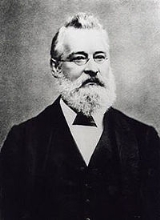
English chemist John Alexander Reina Newlands (1837-1898), having arranged the 62 known elements in order of increasing atomic weights, noted that after interval of eight elements similar physical/chemical properties reappeared.
Newlands was the first to formulate the concept of periodicity in the properties of the chemical elements. In 1864 and 1865, he wrote a series of papers proposing the Law of Octaves which stated that any given element will exhibit analogues behaviour to the eighth element following it in the table. In other words, when he listed in order of increasing atomic weight, similar physical and chemical properties recurred at intervals of eight, which he likened to the octaves of music. However, Newlands was so enthralled with this "law of octaves" that he made the mistake of trying to force the elements into this pattern.
Newlands’ Octave:
H Li Ga B C N O
F Na Mg Al Si P S
Cl K Ca Cr Ti Mn Fe
Co,Ni Cu Zn Y In As Se
Br Rb Sr Ce,La Zr Di,Mo Ro,Ru
Pd Ag Cd U Sn Sb Te
I Cs Ba,V Ta W Nb Au
Pt,Ir Tl Pb Th Hg Bi Cs
The elements are ordered by atomic weights that were known at the time. They were numbered sequentially to show the order of atomic weights. In Newlands’ table, periods and groups are shown going down and across the table, respectively – the opposite from the modern periodic table.
The incompleteness of a table he drew up 1864 attributed to the possible existence of additional, undiscovered elements. For example, he predicted the existence of germanium.
However, there are obvious problems with Newlands' table of the elements. The first row, for example, group elements with similar chemical properties such as Fluorine, Chlorine, Bromine and Iodine, but it also includes elements that have totally different chemical properties such as Cobalt, Nickel, Palladium, Platinum and Iridium. Furthermore, at a time when elements were being discovered with some regularity, Newlands failed to leave room in his table for new elements.
References:
http://www.britannica.com/EBchecked/topic/167249/Johann-Wolfgang-Dobereiner
http://web.fccj.org/~ethall/period/period.htm
http://www.eoht.info/page/Johann+Dobereiner
http://www.corrosion-doctors.org/Periodic/Periodic-Dobereiner.htm
http://en.wikipedia.org/wiki/Johann_Wolfgang_Döbereiner
http://chemed.chem.purdue.edu/genchem/history/dobereiner.html
http://en.wikipedia.org/wiki/John_Alexander_Reina_Newlands
http://www.nndb.com/people/480/000103171/
http://dl.clackamas.cc.or.us/ch104-07/newlands.htm
http://www.britannica.com/EBchecked/topic/412978/John-Alexander-Reina-Newlands
Wednesday, June 29, 2011
Dragonfly walk to Venus Drive
I would deem myself as quite passionate in dragonfly and since 5-year old, I had already started observing dragonfly. Therefore, I have a decent amount of knowledge to lead a walk on dragonflies. The weather was very good that day, with the sun hanging in the sky that shone brightly onto the stream, making the stream sparkle......Though it was a little bit hot, it was a perfectly good day for dragonfly-watching as dragonflies are cold-blooded and they need to warm up in the Sun to be active.
There was a lot of habitats in Venus trail, including mud patches, streams, ponds, shady stagnant pools...and from all these habitats, we could find a certain amount of dragonfly species. The day started off very good, because in the open stream, which was expected to have lesser species as it is not in the forest, turns out quite good as we spotted around 10 species. Though all of them are just common species, the people which participated in the walk are still very impressed by the colours of the dragonflies as they did not take a good look at these species before. In addition, we also found some common species mating, like the ceriagrion cerinorubellum and the Orthetrum Chrysis. (Sorry for using latin names as I am not really sure with the common names, as I just got to know the names about a few months ago)
A surprise was in store for us later when we went into the forest. On a stagnant pool, I spotted a Gynacantha dohrni hovering over a stagnant pool. This species is a crepuscular species that is rarely spotted in the morning unless we bashed into the dense bushes. Though it was a less seen species, it is dull green in colour and the colour is not very striking. Therefore, I was not very sure if the people who attended the talk knew really appreciated it. Around the stagnant pool, we also spotted a special damselfly that opened it's wings when rested instead of opening. Other than that, we also spotted a blue-red-and-yellow species that was quite rare as it mostly appeared in the Central Catchment area.
As we continued to a forest stream, we spotted two big metallic green damselfly that was fluttering under the sun, it's wings shimmering with blue. This two damselfly was displaying and flying facing each other. However, it is a very secretive species and not long after, it flew down the stream and disappeared. Therefore, only a few people saw this species.
Lastly, as we continued to a pond, we also spotted a few species mating. The damselflies mate in a way that a heart-shape was form when they attached their appendages and ovipositors to each other and after mating, we saw them ovipositing in the Tandem guarding method, which is the male's appendage hooked to the female's thorax while it is ovipositing. The dragonflies flew around together, and they practiced Non-contact guarding, which was the male hovering above, guarding the female while the female is ovipositing in the water.
At last, we came to the end of the walk, which was very sastifactory. Overall, we spotted 22 species, which was around 1/6 of the total dragonflies in Singapore (125 species in Singapore, with the recent discovery of zyxomma obtusum in Pulau Ubin).
There was a lot of habitats in Venus trail, including mud patches, streams, ponds, shady stagnant pools...and from all these habitats, we could find a certain amount of dragonfly species. The day started off very good, because in the open stream, which was expected to have lesser species as it is not in the forest, turns out quite good as we spotted around 10 species. Though all of them are just common species, the people which participated in the walk are still very impressed by the colours of the dragonflies as they did not take a good look at these species before. In addition, we also found some common species mating, like the ceriagrion cerinorubellum and the Orthetrum Chrysis. (Sorry for using latin names as I am not really sure with the common names, as I just got to know the names about a few months ago)
A surprise was in store for us later when we went into the forest. On a stagnant pool, I spotted a Gynacantha dohrni hovering over a stagnant pool. This species is a crepuscular species that is rarely spotted in the morning unless we bashed into the dense bushes. Though it was a less seen species, it is dull green in colour and the colour is not very striking. Therefore, I was not very sure if the people who attended the talk knew really appreciated it. Around the stagnant pool, we also spotted a special damselfly that opened it's wings when rested instead of opening. Other than that, we also spotted a blue-red-and-yellow species that was quite rare as it mostly appeared in the Central Catchment area.
As we continued to a forest stream, we spotted two big metallic green damselfly that was fluttering under the sun, it's wings shimmering with blue. This two damselfly was displaying and flying facing each other. However, it is a very secretive species and not long after, it flew down the stream and disappeared. Therefore, only a few people saw this species.
Lastly, as we continued to a pond, we also spotted a few species mating. The damselflies mate in a way that a heart-shape was form when they attached their appendages and ovipositors to each other and after mating, we saw them ovipositing in the Tandem guarding method, which is the male's appendage hooked to the female's thorax while it is ovipositing. The dragonflies flew around together, and they practiced Non-contact guarding, which was the male hovering above, guarding the female while the female is ovipositing in the water.
At last, we came to the end of the walk, which was very sastifactory. Overall, we spotted 22 species, which was around 1/6 of the total dragonflies in Singapore (125 species in Singapore, with the recent discovery of zyxomma obtusum in Pulau Ubin).
Wednesday, June 1, 2011
Sea level rising
Global warming is causing the earth's temperature to rise about half a degree Celsius in the past 100 years. Half a degree might seem to you to be just a very small number, however, it is big enough to affect our planet.The main ice could be found at Antarctica, which is at the South Pole, with about 90 percent of the world's ice and 70 percent of its fresh water. Antarctica is covered with ice an average of 2,133 meters. If all of the Antarctic ice melted into the vast sea, sea levels around the world would rise about 61 meters. But the average temperature in Antarctica is -37°C, so the ice there is in no danger of melting. But there might be a less shocking reason than polar ice melting for the higher ocean level -- the higher temperature of the water. Water is most dense at 4 degrees Celsius. Whether the temperature is higher or lower, the density of water would decrease. So as the overall temperature of the water is rising, it naturally expands a little bit making the oceans level increase. Researches had estimate that the sea will rise 50 centimeters with the lowest estimates at 15 centimeters and the highest at 95 centimeters. The rise of the sea level will come from the melting glaciers and ice sheets which are caused by the gradually increasing temperature of the planet. Could you imagine if the Polar Caps rises until it covers the whole Singapore? I hope it would not work out this way. Therefore, the message to learn from this rising of sea level is start conserving now!
Subscribe to:
Posts (Atom)