
The development of the periodic table begins with German chemist Johann Wolfgang Döbereiner (1780-1849) who grouped certain elements based on similarities and anticipated the development of the periodic system of elements, such as grouping the group I (alkali metal) elements lithium, sodium and potassium together for being soft, reactive metals. He also noticed other patterns in the group I elements, such as all react with water at room temperature and react with chlorine to form compounds with similar formulas: LiCl, NaCl, and KCl, combine with hydrogen to form compounds with similar formulas: LiH, NaH, and KH and form hydroxides with similar formulas: LiOH, NaOH, and KOH.
Döbereiner recalled a comparable graduation of properties in two other sequences—calcium, strontium, barium; and sulfur, selenium, tellurium. Calcium (atomic weight 40), strontium (atomic weight 88), and barium (atomic weight 137) possess similar chemical prepares and Döbereiner noticed the atomic weight of strontium fell midway between the weights of calcium and barium:
Calcium (Ca) Strontium (Sr) Barium (Ba)
40 88 137
(40 + 137) ÷ 2 = 88
Dobereiner also noticed the same pattern for the alkali metal triad, lithium (Li), sodium (Na) and potassium (K) and the halogen triad, chlorine (Cl) Bromine (Br) and Iodine (I). Furthermore, Dobereiner found that the density of the middle element in most triads is roughly equal to the average of the densities of the other elements. The density of strontium (2.60 g/cm3), for example, is close to the average of the densities of calcium (1.55 g/cm3) and barium (3.51 g/cm3).
In 1829, Dobereiner proposed the Law of Triads: Middle element in the triad had atomic weight that was roughly the average of the other two members. Soon other scientists found chemical relationships extended beyond triads. Fluorine was added to halogen group; sulfur, oxygen, selenium and tellurium were grouped into a family; nitrogen, phosphorus, arsenic, antimony, and bismuth were classified as another group.
Attempts made by John Alexander Reina Newlands:
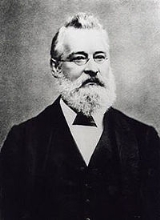
English chemist John Alexander Reina Newlands (1837-1898), having arranged the 62 known elements in order of increasing atomic weights, noted that after interval of eight elements similar physical/chemical properties reappeared.
Newlands was the first to formulate the concept of periodicity in the properties of the chemical elements. In 1864 and 1865, he wrote a series of papers proposing the Law of Octaves which stated that any given element will exhibit analogues behaviour to the eighth element following it in the table. In other words, when he listed in order of increasing atomic weight, similar physical and chemical properties recurred at intervals of eight, which he likened to the octaves of music. However, Newlands was so enthralled with this "law of octaves" that he made the mistake of trying to force the elements into this pattern.
Newlands’ Octave:
H Li Ga B C N O
F Na Mg Al Si P S
Cl K Ca Cr Ti Mn Fe
Co,Ni Cu Zn Y In As Se
Br Rb Sr Ce,La Zr Di,Mo Ro,Ru
Pd Ag Cd U Sn Sb Te
I Cs Ba,V Ta W Nb Au
Pt,Ir Tl Pb Th Hg Bi Cs
The elements are ordered by atomic weights that were known at the time. They were numbered sequentially to show the order of atomic weights. In Newlands’ table, periods and groups are shown going down and across the table, respectively – the opposite from the modern periodic table.
The incompleteness of a table he drew up 1864 attributed to the possible existence of additional, undiscovered elements. For example, he predicted the existence of germanium.
However, there are obvious problems with Newlands' table of the elements. The first row, for example, group elements with similar chemical properties such as Fluorine, Chlorine, Bromine and Iodine, but it also includes elements that have totally different chemical properties such as Cobalt, Nickel, Palladium, Platinum and Iridium. Furthermore, at a time when elements were being discovered with some regularity, Newlands failed to leave room in his table for new elements.
References:
http://www.britannica.com/EBchecked/topic/167249/Johann-Wolfgang-Dobereiner
http://web.fccj.org/~ethall/period/period.htm
http://www.eoht.info/page/Johann+Dobereiner
http://www.corrosion-doctors.org/Periodic/Periodic-Dobereiner.htm
http://en.wikipedia.org/wiki/Johann_Wolfgang_Döbereiner
http://chemed.chem.purdue.edu/genchem/history/dobereiner.html
http://en.wikipedia.org/wiki/John_Alexander_Reina_Newlands
http://www.nndb.com/people/480/000103171/
http://dl.clackamas.cc.or.us/ch104-07/newlands.htm
http://www.britannica.com/EBchecked/topic/412978/John-Alexander-Reina-Newlands

No comments:
Post a Comment